
Moo Dō (Martial Way)
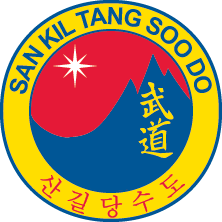
The way of preventing conflict. Moo = military, chivalry, martial; within the ideograph the inner part of the symbol is the word for "stop" and the long brush stroke on the outer part that looks like a sword means "weapon". Moo 武 graphically combines the ka 戈 radical and zhi 止 radical. The character 戈 means spear. While the character 止 means “to stop”. It originally meant “foot” in ancient script. The character 武 may therefore have originally referred to “a man on foot with a spear” and thus conveyed military. Due to the modern meaning of 止, Moo is more commonly used denote “to stop a weapon” or “to stop violence”.
Dō = "way"; while the character itself translates as "way," "path," or "route," or sometimes more loosely as "doctrine" or "principle," it is used philosophically to signify the fundamental or true nature of the world. Dō 道 graphically combines the chuo 辶 (or 辵) "go; advance" radical and shou 首 "head" phonetic. This combination signified a "head going" or "to lead the way". The Confusion citation of Dō verbally meaning "to guide; to lead" is: "In guiding a state of a thousand chariots, approach your duties with reverence and be trustworthy in what you say." Confucius taught that Dō (or Tao in Chinese) was a "way", the 'way' of moral integrity. Lao-Tzu interpreted Do as the law, or truth of the universe. Over the course of history Dō has evolved into the present nearly universally accepted meaning of acting with virtue according to nature.
Combined these characters represent "the way of preventing conflict". Conflict resolution on an external and more importantly internal basis is one of the major goals of Tang Soo Do practice. Here the color gold and placement within the mountain conveys the riches one finds when digging deeper within one-self thru training.
Dō = "way"; while the character itself translates as "way," "path," or "route," or sometimes more loosely as "doctrine" or "principle," it is used philosophically to signify the fundamental or true nature of the world. Dō 道 graphically combines the chuo 辶 (or 辵) "go; advance" radical and shou 首 "head" phonetic. This combination signified a "head going" or "to lead the way". The Confusion citation of Dō verbally meaning "to guide; to lead" is: "In guiding a state of a thousand chariots, approach your duties with reverence and be trustworthy in what you say." Confucius taught that Dō (or Tao in Chinese) was a "way", the 'way' of moral integrity. Lao-Tzu interpreted Do as the law, or truth of the universe. Over the course of history Dō has evolved into the present nearly universally accepted meaning of acting with virtue according to nature.
Combined these characters represent "the way of preventing conflict". Conflict resolution on an external and more importantly internal basis is one of the major goals of Tang Soo Do practice. Here the color gold and placement within the mountain conveys the riches one finds when digging deeper within one-self thru training.
